Carfax vs. AutoCheck: Which Is Better in 2026?
Compare CARFAX and AutoCheck records, scores, buyback terms and current offers. Learn which free VIN checks to run before paying.
Enter your VIN. Check the car before you buy.
Identify the vehicle free, then choose whether to buy its reported history.
Title brands · Odometer records · Auction history, where reported
No subscription. No charge to check the VIN. Report contents vary by vehicle; applicable tax is shown at checkout.
See what the paid report includes →Choose CARFAX when reported service and maintenance history matters most; choose AutoCheck when auction history and comparing several vehicles matter most. Neither report can reveal every unreported accident. Ask the seller for an existing report before buying one. For a separate title, salvage and odometer check, VIN Lookup offers a $14.99 one-time report fulfilled by ClearVIN, with no subscription. This site publishes the comparison and sells that separate product; it is not a CARFAX or AutoCheck report.
- Published CARFAX prices conflict across sources, and AutoCheck package details can change. Verify each seller’s current checkout before comparing totals.
- Carfax (Mobility Global, formerly S&P Global Mobility) leans on 151,000+ sources and service records; AutoCheck (Experian) leans on auction data and its patented score.
- The Justice Department states consumers cannot obtain NMVTIS reports from Carfax or Experian; a separate approved consumer provider may offer free or paid access.
- Both reports can miss events that were never reported, so the free NICB and NHTSA checks still matter.
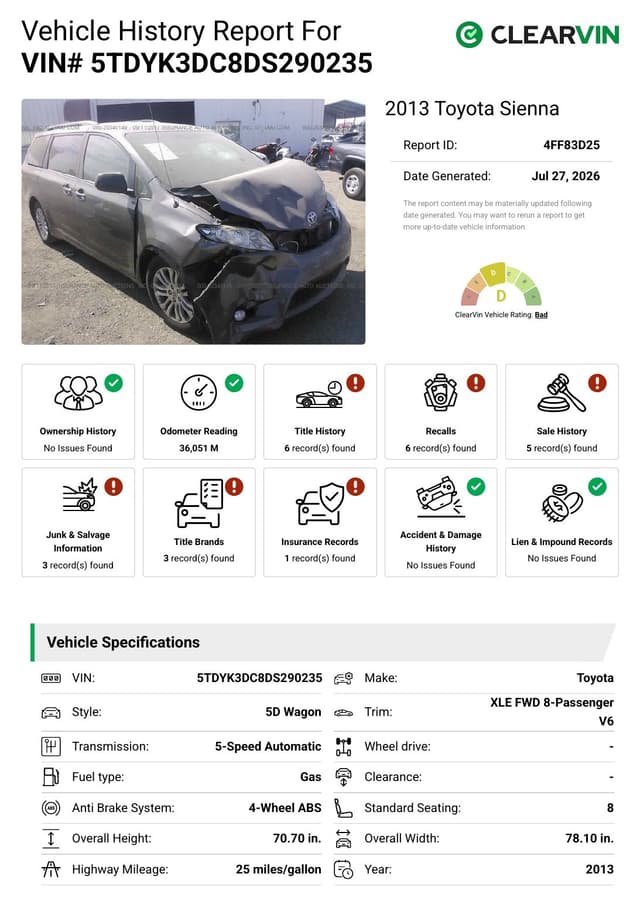
See the evidence on a real sample
Explore the original ClearVIN document alongside explanations of its title brands, mileage timeline and auction damage descriptions. Each finding belongs to the sample VIN.
Explore the annotated sample →Do you need either paid report yet?
First ask the seller for an existing report and confirm the VIN. Run the free identity, theft and recall checks, then choose a paid report for the history question that remains. Carfax and AutoCheck have distinct sources; a cheaper report does not establish equivalent coverage.
VIN Lookup, the publisher of this comparison, also offers an optional $14.99 one-time report fulfilled by ClearVIN. The free identity check requires no card, and the original provider sample can be viewed before purchase. The paid product delivers a provider PDF for your VIN with the records returned; it is not a Carfax or AutoCheck report and has no recurring subscription.
Compare reports. Then check your car.
Identify the vehicle free, then choose whether to buy its reported history.
Title brands · Odometer records · Auction history, where reported
No subscription. No charge to check the VIN. Report contents vary by vehicle; applicable tax is shown at checkout.
See what the paid report includes →Two owners, two data strategies
AutoCheck is an Experian product: autocheck.com carries Experian's terms and 2026 copyright, and describes its data as aggregated and managed by Experian. Carfax's answer to the ownership question changed recently. Its about page now describes Carfax as part of Mobility Global, and mobilityglobal.com states plainly that S&P Global Mobility is now Mobility Global, listing Carfax among its core brands. So shoppers who read that Carfax belongs to S&P Global are reading the pre-rebrand name of the same automotive-data business.
The databases behind the two reports are built differently. Carfax's about page claims more than 151,000 data sources—U.S. federal and state agencies, Canadian provincial motor vehicle agencies, auto auctions, fire and police departments, and fleet and rental operators—feeding a database of over 35 billion records, with reports available for vehicles from model year 1981 onward. AutoCheck's site cites data from 95% of all U.S. auction houses, most providing exclusive structural damage announcements, plus tens of thousands of distinct accident sources; its comparison page also claims title and registration data from all 50 states and the District of Columbia and exclusive auction-announced data from the two largest U.S. auctions.
What the two share matters as much as what separates them. Both are commercial reports assembled from licensed and reported data, which means both can miss a crash that generated no insurance claim or police report. And on the U.S. Department of Justice's NMVTIS provider page, both appear on the commercial-only side: the page states that consumers cannot receive NMVTIS vehicle history reports from Carfax or Experian.
What each report costs, and where the figures come from
Published CARFAX and Edmunds examples disagree on CARFAX prices, and Edmunds's table and prose disagree on one pack size. The sellers' live checkouts were not verified in this review (September 23, 2026). Check the seller's current price, pack size, expiry and total before buying.
CARFAX’s own August 2025 article and Edmunds’s June 2026 comparison list different report prices. Edmunds’s table and prose also disagree on the number of reports in one pack. Neither example establishes today’s CARFAX offer, so check the seller’s checkout for its current single-report price, pack size and activation window. Its own customer agreement notes that CARFAX may not have the complete history of every vehicle.
AutoCheck advertises single and multi-report options, but the published comparisons we reviewed also disagree on the multi-report amount. Check AutoCheck’s checkout for the total, number of reports, access window and any renewal terms before comparing it with CARFAX or another provider.
The table below condenses the differences that show up on the two companies' own pages.
| Feature | Carfax | AutoCheck | VIN Lookup (this site) |
|---|---|---|---|
| Single report price | Check seller’s current price | Check seller’s current price | $14.99 |
| Multi-report packs | Check seller’s current packages | Check seller’s current packages | $29.99 for 3 ($10.00 each); $44.99 for 5 ($9.00 each), no expiry |
| Owner | Mobility Global (formerly S&P Global Mobility) | Experian | VIN Lookup; the report is fulfilled by ClearVIN |
| Claimed database | Over 35 billion records from 151,000+ sources | Data from 95% of U.S. auction houses; tens of thousands of accident sources | The NMVTIS federal core, plus ClearVIN's licensed auction records and photos; no comparable proprietary network |
| Service history | Service records and state emissions inspection results | Repair records and reported inspections, without Carfax's service-record emphasis | Not a service-record product; Carfax is the stronger choice when maintenance history decides the purchase |
| Summary score | None; events plus a History-Based Value | Patented AutoCheck Score (U.S. Patent No. 8,005,759) | None; the provider PDF is delivered without a score or a rewritten summary |
| Auction data | Auto auctions among its listed sources | Exclusive announcements from the two largest U.S. auctions, per its comparison page | Licensed auction records with prices and available photos, when on file for the VIN |
| Buyback program | Carfax Buyback Guarantee if a DMV-issued branded title is missed | AutoCheck Buyback Protection for registered qualifying vehicles | Not offered |
| Free access | Report included with Carfax used-car listings and many dealer listings | Free record-count search on partner sites such as Kelley Blue Book | Free VIN identity decode on any VIN with no card, and the original provider sample readable before paying |
| NMVTIS consumer reports | No; DOJ lists Carfax as commercial-only | No; DOJ lists Experian as commercial-only | Yes, through ClearVIN, a DOJ-approved consumer access provider |
| Purchase model | One-time purchase | One-time purchase; five-report pack expires after 21 days | One-time purchase, no subscription, no automatic renewal, and credits that do not expire |
When Carfax is the better buy—and when AutoCheck is
Choose Carfax when maintenance history would change your decision. Its report structure surfaces service records—oil changes, brake and transmission work, safety inspections—alongside state emissions results, accident indicators with point of impact and severity, and type-of-use flags such as taxi, rental, or police service. There is also a legitimate free route: Carfax states that every listing on its used-car marketplace comes with a free report, and many dealers attach one to advertised inventory, so on a dealer car you may not need to buy anything.
Choose AutoCheck when you are screening several candidates or shopping segments that pass through auctions—off-lease returns, repossessions, dealer trades. Its auction coverage claim is the core of its pitch, and the patented AutoCheck Score gives a one-number comparison across similarly aged vehicles. Check the current multi-report offer and expiry before buying. Kelley Blue Book's history page runs a free AutoCheck search that returns the number of records on file, a useful zero-cost signal before paying.
Both companies back their reports with conditional protection programs: Carfax's Buyback Guarantee applies when a report failed to include a DMV-issued branded title, and AutoCheck's Buyback Protection covers registered, qualifying vehicles when a covered title brand surfaces later. Read each program's terms before treating it as insurance.
The free and low-cost checks to run either way
Before buying any report, spend nothing: NICB VINCheck screens vehicles reported stolen and not recovered plus salvage or flood total-loss records from participating insurers representing 92.49% of U.S. earned premium as of August 2026, limited to five searches per IP address per 24 hours. NHTSA's recall lookup shows whether a VIN has an unrepaired safety recall—though not recalls already fixed, recalls more than 15 years old, or campaigns from some small-volume manufacturers. A free VIN decode confirms the car's identity matches the paperwork.
For title brands, odometer readings, and reported total-loss and salvage history, get a separate NMVTIS-backed report from a DOJ-approved consumer provider. Carsforsale.com advertises free reports; paid examples include VinAudit at $9.99 for one report in August 2026. State title records, covered insurer reports, and qualifying junk or salvage-business reports can reveal a brand absent from another commercial report. The reverse also happens; an older vehicle may lack an insurer record under the federal reporting minimum.
A sensible order: free checks on every candidate, an NMVTIS report on a serious contender (checking whether a free offer covers that VIN), then Carfax or AutoCheck on a finalist when service or accident detail would change the decision.
Buyer checklist
- Run the free NICB and NHTSA checks before paying for any report.
- Order an NMVTIS report for title brands and odometer records; compare current provider terms first.
- Pick Carfax when service-history depth would change your decision, or get it free with a listing.
- Pick AutoCheck to screen several auction-sourced candidates if its current package terms fit your shortlist.
- Read whichever report you buy chronologically and verify adverse records at their source.
What this research cannot prove
- Published CARFAX and Edmunds examples disagree on CARFAX prices, and Edmunds's table and prose disagree on one pack size. The sellers' live checkouts were not verified in this review (September 23, 2026). Check the seller's current price, pack size, expiry and total before buying.
- Database figures such as 35 billion records or 95% auction coverage are the providers' own marketing claims, not audited counts.
- Neither report includes events never reported to its sources; a clean report is not proof of a clean history.
- NMVTIS title, brand, and odometer data requires a separate report from a DOJ-approved consumer provider.
Sources reviewed
Open the underlying public source and verify that its scope matches the question you are asking.
- How to Read a CARFAX ReportCARFAX
- AutoCheck vs. Carfax: Which Vehicle History Report Is Best for You?Edmunds
- VIN Lookup report pricing and purchase termsVIN Lookup — this site’s own product
- Original provider sample and coverage limitsVIN Lookup
- CARFAX Vehicle History ReportsCARFAX
- AutoCheck Vehicle History ReportsExperian Automotive
- About CARFAXCARFAX (Mobility Global)
- Mobility Global — formerly S&P Global MobilityMobility Global
- AutoCheck vs. CARFAXExperian Automotive
- Vehicle History Report & VIN CheckKelley Blue Book (Cox Automotive)
- Understanding an NMVTIS Vehicle History ReportU.S. Department of Justice
- NMVTIS Vehicle HistoryU.S. Department of Justice
- Free Vehicle History Reports — NMVTIS-backed offerCarsforsale.com
- VINCheckNational Insurance Crime Bureau
- Recalls Lookup by VINNational Highway Traffic Safety Administration
- VinAudit Vehicle History ReportsVinAudit
Frequently asked questions
Is AutoCheck cheaper than Carfax?
Do not assume the historical article prices still apply. Published CARFAX examples disagree, and AutoCheck’s offer can change too. Compare the current single-report total, pack size and expiry at each seller’s checkout.
Which is better, Carfax or AutoCheck?
Neither wins for every car. CARFAX’s 151,000-plus claimed sources emphasize service and emissions records; AutoCheck cites auction data from 95% of U.S. auction houses plus a comparison score. Match the report to your question and compare current checkout terms—both can miss unreported damage.
Is Carfax owned by S&P Global?
Carfax is part of Mobility Global, the automotive-data company formerly branded S&P Global Mobility, which lists Carfax among its core brands. AutoCheck belongs to Experian. Both are commercial data companies, not government databases.
Can I get a Carfax or AutoCheck report for free?
Sometimes, through listings. Carfax states every listing on its used-car marketplace includes a free report, and many dealers attach one. Kelley Blue Book's history page runs a free AutoCheck search, but it returns only the number of records.
Do Carfax and AutoCheck include NMVTIS title data?
Not for consumers. The Justice Department says consumers cannot receive NMVTIS reports from Carfax or Experian, whose NMVTIS access serves commercial customers. DOJ-approved consumer providers supply that separate record: Carsforsale.com advertises a free NMVTIS-backed report, while VinAudit listed a $9.99 paid offer in August 2026.
What do both Carfax and AutoCheck miss?
Any event never reported to their sources: crashes without insurance claims or police reports, cash repairs, and records that reach NMVTIS but not commercial databases. A clean report narrows risk; it does not replace an independent inspection.